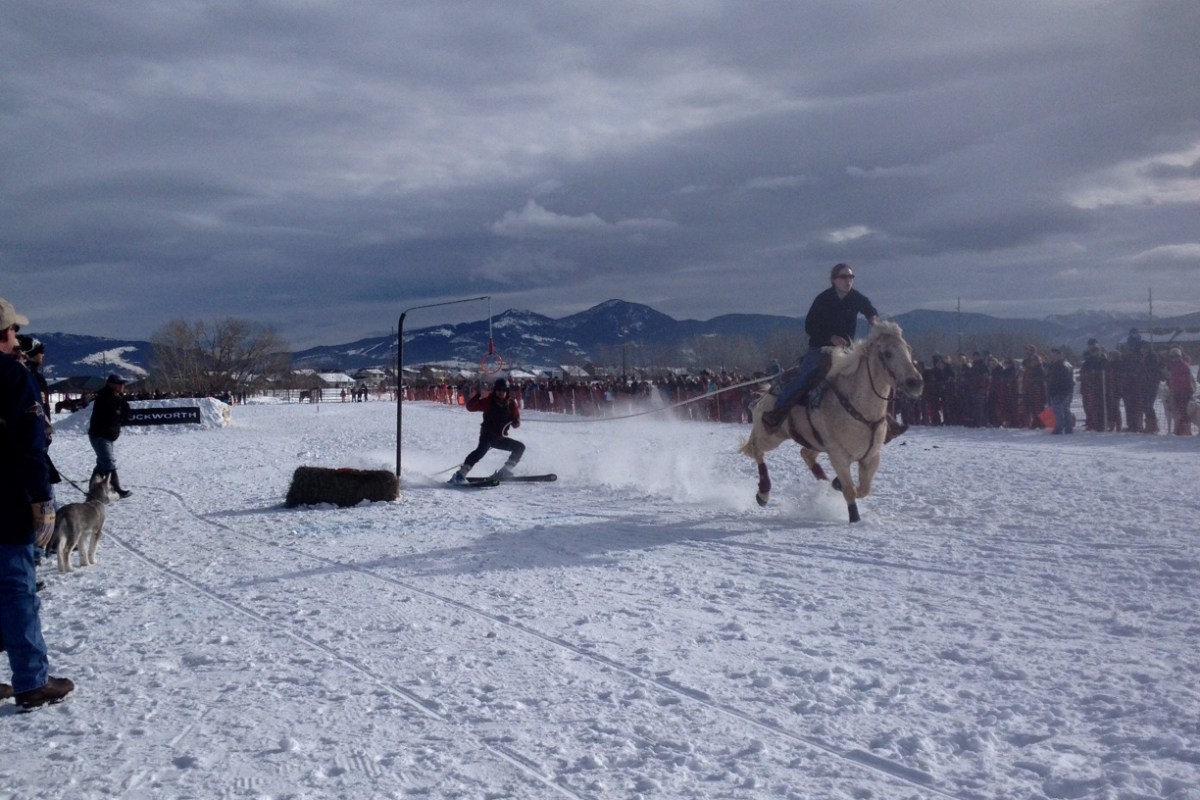
The crowd whooped as the skier landed the jump, groaned as he fell cutting a turn too sharply, and broke into loud applause and cheers when he stood up and brushed the snow off himself. The horse and rider disappeared down the course as the country voice emceeing the event encouraged the crowd to give the downed competitor one more round of applause. Less than a minute later another horse and rider with skier in tow raced down the course, this time staying upright as the crowd encouraged her the whole way.
Skijoring’s roots begin in Scandanavia and while it is not new activity, it was a demonstration 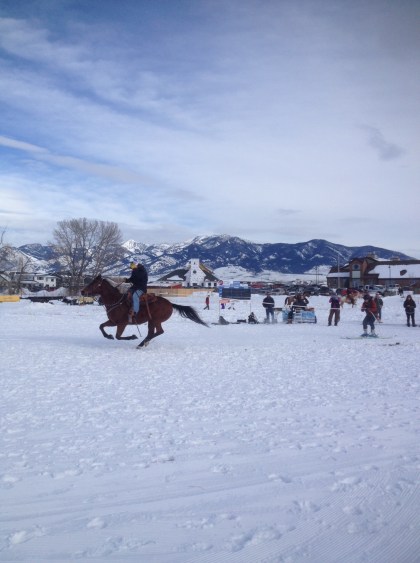 sport in the 1928 Olympics, organized competitions in North America are fairly recent. Luckily I was accompanied to the skijoring competition with my Swedish friend Anna who skijored (I’m wading into unknown territory using variations of “skijoring”) as a kid growing up in Sweden. When I asked what she remembered of the occasion she replied “Faceplanting….a lot”. When I followed up asking how many times she skijored she said “Once,” in a way that implied once was more than enough.
There are not many sports easier to explain or understand. A horse and rider pull a skier (it was hard to figure if the horse and rider were a team or randomly assigned) by rope through a course that includes jumps, gates that must be navigated, and a ring which is grabbed by the rider and held until crossing the finish line. The fastest time wins. Penalties in the form of seconds are added to a team’s time depending on which obstacle is missed. A wholesome, well-produced video of skijoring can be seen here.
The competition is divided into three classes: novice, sport and open. Most of the professionals compete in the open class. Anna and I arrived as the sport class was beginning and the speed of the non-professionals surprised me. However not everyone was worried about their time. One of skiers in the sport class wore a gorilla suit. Another on a snowboard took about forty seconds (the average time was in the twenties) to complete the course with a Bronx cheer erupting when he finally crossed the finish line.
The open class was a bit more serious, but the theme of day seems more about fun than winning. The finish line official held a flag to signal the timekeeper the competitor has finished in one hand and a bottled beer in the other. Half the crowd lining the course joined him, enjoying a Montucky tall boy while watching the competition. Skijoring seems quintessential Montana, a majority of the people in attendance ride horses or ski. Just not at the same time. Anna joined a conversation with other horse riders around us wondering if it’s in their future. The consensus was….maybe.
One of the last teams was a younger woman on horseback and brightly colored twenty-something male pulled behind her. They both looked the part, she in her western shirt and cowboy hat, he wearing loud ski attire with heavily graphic-ed helmet and goggles.
Out of the gate she yelled encouragement to her long-haired, tan horse while he immediately pulled the slack out of the rope to increase speed. Like a well-oiled machine she gets as much out of the horse as he navigates with precision each gate and jump. As they passed us by, her shouts are followed by the whoosh of his skis, the length of the rope so short he pulls even with the horse on the jumps. From behind he seemed out of position for the last gate but in a deep crouch and with a sudden shift of his body he made the gate and crossed with the fastest time so far.
We stayed until the end of the open class, the competition is spread out over two days with the times of the first day combined with the second day’s runs. The late afternoon chill began creeping up on us and with the coffee truck sold out it was time to head indoors to warm up. Heading back to the car across the snow-packed field, we paused to let a older gentleman on horseback cross our path- a young, yellow labrador on the horse’s heels. In the distance clouds cut off the tops of the snow-covered Bridger Mountains. Like I said, quintessential Montana.
 The Bucklin Life